Common Vinyl Siding Cleaning Mistakes: An Editorial Technical Guide
The maintenance of polyvinyl chloride (PVC) exterior cladding is often viewed through the lens of simple aesthetics—a seasonal chore intended to restore the original luster of a home’s facade. However, the chemistry and physics of vinyl siding require a more nuanced approach than most residential maintenance tasks. Common Vinyl Siding Cleaning Mistakes. Improper cleaning techniques do not merely result in a less-than-pristine surface; they can initiate a sequence of material degradation and structural vulnerability that compromises the entire building envelope.
Understanding the risks involved begins with a realization that vinyl siding is a water-shedding system, not a waterproof one. Its integrity relies on a series of laps, weep holes, and interlocking joints designed to manage gravity-fed liquid. When external pressure or chemical agents are introduced incorrectly, this sophisticated hydraulic management system is easily bypassed. The result is often moisture entrapment behind the panels, leading to unseen organic growth and substrate rot.
Furthermore, the surface of modern vinyl is an engineered layer. It features specific capstock formulations designed to resist ultraviolet radiation and maintain color consistency. Aggressive cleaning methodologies can strip these protective layers, leading to premature oxidation and “chalking.” This article serves as an analytical deep dive into the technical pitfalls of siding maintenance, providing a framework for preserving both the material and the underlying structure.
Understanding “common vinyl siding cleaning mistakes”
To define common vinyl siding cleaning mistakes, one must look beyond the immediate visual outcome. A mistake in this context is any action that prioritizes short-term cleanliness at the expense of long-term material stability or structural dryness. These errors generally fall into two categories: mechanical force and chemical aggression.
A prevalent misunderstanding is the belief that higher pressure equates to a deeper clean. In the world of exterior restoration, pressure is often a substitute for patience and proper chemistry. When high-velocity water is directed at vinyl, it can easily get behind the “lap” of the siding. This introduces moisture into the wall cavity where it was never intended to go. Because vinyl is an effective vapor barrier, this water becomes trapped, saturating the house wrap and eventually the sheathing.
Oversimplification also leads to chemical mismanagement. Homeowners frequently reach for household bleach or abrasive scouring pads without considering the pH balance or the physical hardness of the cleaning tool relative to the PVC surface. These decisions can lead to micro-abrasions that, while invisible to the naked eye, provide a textured foothold for future mold and mildew growth, necessitating more frequent and aggressive cleaning in a self-defeating cycle.
Evolution of Maintenance Protocols
Historically, exterior maintenance was a matter of high-effort scrubbing or simple hose-rinsing. As vinyl siding became the dominant cladding in the late 20th century, the industry shifted toward “soft washing”—a technique that prioritizes chemical surfactants over mechanical force. However, the democratization of high-pressure equipment has created a disconnect. Professional-grade power washers are now readily available for rent or purchase by untrained users, leading to a surge in siding damage that was historically rare.
Modern siding formulations have also evolved. Contemporary “dark” vinyl panels utilize advanced pigments and heat-reflective technology. These materials are more sensitive to certain chemical solvents than the light-grey or beige panels of the 1980s. Consequently, a maintenance protocol that worked twenty years ago might today cause irreversible “tiger stripping” or localized bleaching on a modern architectural-grade panel.
Conceptual Frameworks for Surface Care
Effective maintenance is governed by three primary mental models:
-
The Sinner’s Circle: A concept used in industrial cleaning that balances four variables: Temperature, Chemistry, Mechanical Action, and Time. If you reduce one (e.g., Mechanical Action/Pressure), you must increase another (e.g., Time or Chemistry) to achieve the same result.
-
The Hydraulic Path Model: A visualization of how water moves through a wall assembly. If the water’s path is forced upward or inward rather than downward, the system has failed.
-
The Capstock Integrity Buffer: Viewing the top layer of the vinyl as a finite resource. Every aggressive cleaning session “spends” a portion of the UV-protection buffer. The goal is to spend as little as possible.
Categories of Cleaning Failures and Chemical Trade-offs
Choosing a cleaning agent involves a series of trade-offs between speed, safety, and environmental impact.
| Agent Type | Strengths | Weaknesses | Risk Factor |
| Sodium Hypochlorite (Bleach) | Highly effective at killing spores. | High pH can damage capstock; kills vegetation. | High |
| Oxygen Bleach (Sodium Percarbonate) | Environmentally safer; gentler on PVC. | Slower reaction time; less effective on heavy grime. | Low |
| Vinegar/Citric Acid | Natural; good for mineral deposits. | Ineffective against heavy biological growth. | Very Low |
| TSP (Trisodium Phosphate) | Powerful degreaser for oily soot. | Can dull the finish if not rinsed perfectly. | Moderate |
Decision Logic: Chemical Selection
The primary objective should be to use the mildest solution possible that still achieves the desired biological kill rate. If mold is present, a diluted sodium hypochlorite solution is often necessary, but it must be applied with a “downward-only” spray pattern and rinsed thoroughly to prevent the salt residue from attracting more dirt later.
Real-World Scenarios and Secondary Effects Common Vinyl Siding Cleaning Mistakes
Scenario 1: The Upward Spray Failure
A homeowner attempts to clean the second-story siding from the ground using a high-pressure nozzle.
-
Failure Mode: The water is directed upward into the weep holes and under the laps.
-
Secondary Effect: Three weeks later, an interior musty smell develops. The insulation behind the siding has become a damp medium for mold growth, despite the exterior looking perfectly clean.
Scenario 2: The Direct Sun Application
Cleaning solution is applied to a South-facing wall in the middle of a 90°F day.
-
Failure Mode: The solution dries onto the panel before it can be rinsed.
-
Secondary Effect: The chemicals concentrate as the water evaporates, leading to permanent “etching” or white streaks that cannot be washed away.
Scenario 3: The Scouring Pad Incident
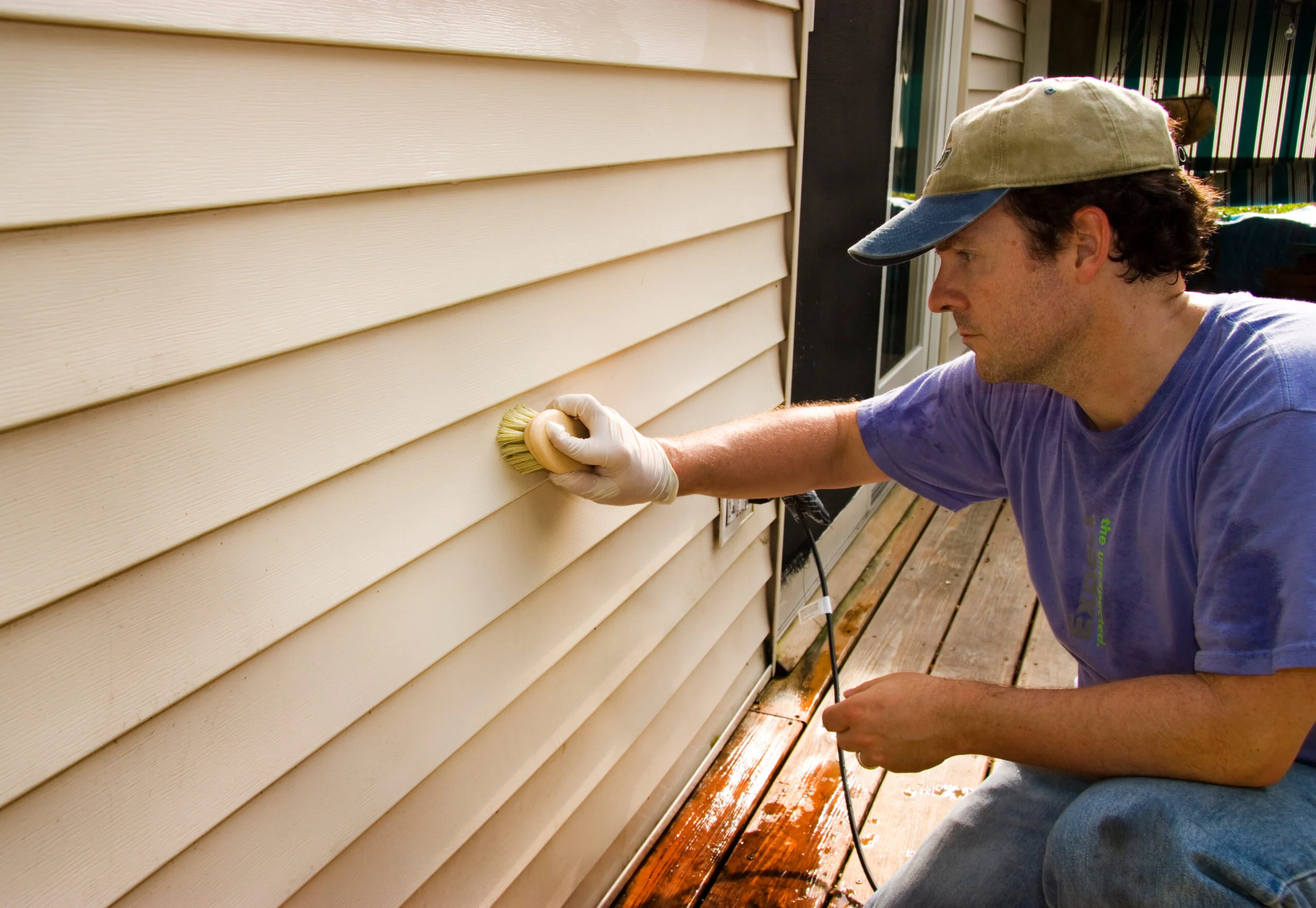
A homeowner uses a green abrasive sponge to remove a stubborn bird-dropping or “artillery fungus” spot.
-
Failure Mode: The abrasive removes the capstock’s gloss.
-
Secondary Effect: The area now has a matte finish that catches dust. Within six months, the spot appears “dirtier” than the rest of the house because the smooth surface has been compromised.
Resource Dynamics: The Cost of Improper Care
While DIY cleaning is often seen as a cost-saving measure, common vinyl siding cleaning mistakes can lead to significant financial liabilities.
| Expense Category | Potential Repair Cost | Root Cause |
| Full Siding Replacement | $12,000 – $25,000 | Chemical bleaching or widespread warping. |
| Mold Remediation (Internal) | $3,000 – $8,000 | High-pressure water intrusion. |
| Professional Restoration | $1,500 – $3,500 | Removing etching/oxidation caused by DIY errors. |
| Landscaping Replacement | $500 – $2,000 | Bleach runoff killing ornamental plants. |
Advanced Toolsets and Safe Systems
-
Downstream Injectors: A system that pulls cleaning chemicals into the water stream after the pump, allowing for low-pressure application.
-
Telescoping Soft-Wash Poles: These allow for the “downward spray” rule to be followed on second stories without using high pressure from the ground.
-
Surfactant Additives: Specialized soaps that “cling” to vertical surfaces, increasing the “Time” variable of the Sinner’s Circle without requiring more aggressive chemistry.
-
pH-Neutral Rinses: Used after bleach applications to stabilize the surface of the PVC.
-
Soft-Bristle Brushes: Long-handled brushes designed specifically for vehicles or siding, ensuring mechanical action doesn’t scratch the plastic.
Risk Taxonomy and Compounding Failures
-
Thermal Shock: Using very cold water on a wall that has been baking in the sun. This can cause the vinyl to crack as it rapidly contracts.
-
Oxidation Mobilization: If siding is already old and “chalky,” improper cleaning can move that white chalk onto windows and trim, where it dries like a semi-permanent paint.
-
Fastener Displacement: High-pressure water hitting the nailing hem can actually “unhook” panels or loosen fasteners that were already near their friction limit.
Governance and Long-Term Adaptation
A successful maintenance regime is iterative. It involves monitoring the rate of biological return and adjusting the chemistry accordingly.
-
Semi-Annual Inspections: Checking North-facing walls for early greening.
-
Rinse-Only Intervals: Most dust and pollen can be removed with a garden hose and a 40-degree nozzle, avoiding chemicals entirely for 2 out of every 3 cleaning cycles.
-
Shadow Line Monitoring: Looking for any warping that might indicate water is trapped behind a specific panel.
Measurement and Evaluation Metrics
-
The White Glove Test: Wiping a dry panel with a dark cloth. Minimal white residue indicates the capstock is still healthy; heavy residue indicates oxidation.
-
The Weep Hole Audit: Ensuring that no cleaning residue or dirt has plugged the small drainage holes at the bottom of each panel.
-
The Plant Vitality Signal: Using the health of the grass at the base of the wall as a lagging indicator of chemical runoff management.
Common Misconceptions and Oversimplifications
-
Myth: “If the siding is green, you need a power washer.” Correction: Green is usually algae, which dies easily with mild surfactants. You need a garden hose and a brush, not 3000 PSI.
-
Myth: “Dish soap is the best cleaner.” Correction: Many dish soaps contain degreasers that can strip the UV protectants from vinyl over time. Use soaps specifically labeled for house washing.
-
Myth: “Power washing is faster.” Correction: Fixing a blown-out window seal or a water-damaged wall takes significantly longer than the extra hour spent soft-washing.
Conclusion
The endeavor of keeping a home’s exterior clean is often fraught with well-intentioned errors. By recognizing the common vinyl siding cleaning mistakes associated with pressure and chemistry, a homeowner can shift from a reactive to a preservative mindset. The goal of siding maintenance should never be a singular, violent event of restoration, but a gentle, consistent process that respects the material limits of the PVC and the structural requirements of the building envelope. In the intersection of chemistry and physics, patience remains the most effective tool for long-term home health.